In Newport, Rhode Island you will find ‘cottages’ that the 19th century rich and famous built to escape the city summer heat. For a winter retreat, they needed to head south, but Florida was mainly swamp in those days so Georgia was their destination. In 1886 John Eugene Du Bignon and his brother-in-law Newton Finney established the Jekyll Island Club which was open only to a limited and very exclusive membership. The island had been named by Georgia founder James Oglethorpe in honour of his friend, Sir Joseph Jekyll. It soon became a plantation island and the Du Bignon family ran a large cotton plantation on the island from 1792 until the Civil War when the plantation was abandoned. The club replaced the plantation business, operating from 1888 to 1942. The island provided a range of activities for its wealthy members, and some even built their own mansion-sized ‘cottages’ on the island.
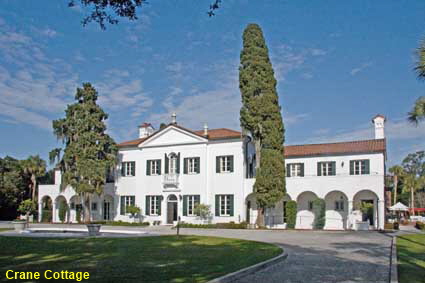
Crane Cottage
The Historic District on Jekyll Island was given National Historic Landmark Status in 1978, preserving the Club and the surrounding ‘cottages’. Crane Cottage was built in 1917 and was the most expensive home built on the island. It was built for Richard Teller Crane Junior who ran the Crane Company from 1914 until his death in 1931. He was the second richest man in Chicago. Built in the Italian Renaissance style, the house had 20 bedrooms. Today it is used as a Bed & Breakfast, Restaurant and a Wedding venue.
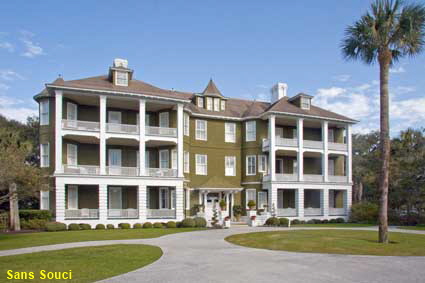
Sans Souci
A small group of club members, including William Rockefeller and J.P. Morgan decided to build one of the first condominiums in the USA rather than separate cottages. Sans Souci was designed by Charles Alling Gifford and it opened in 1896. Although it is now used as part of the hotel, it still has its original floors, leaded glasswork, stairway and skylight.
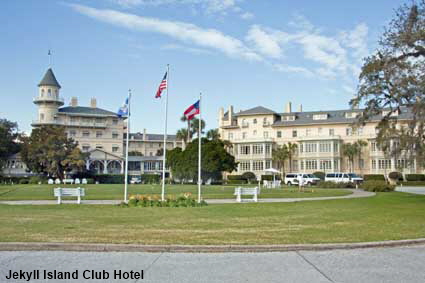
Jekyll Island Club Hotel
World War I and the Great Depression reduced the membership of the Jekyll Island Club, but it was World War II that brought it to an end. The US Government ordered the evacuation of the island, closing the club down. After the war the state of Georgia bought the island intending to turn it into a State Park. The costs proved too high so in 1950 it was taken out of the State Park system and the Jekyll Island Authority set up to look after the island, working with private industry as necessary. The Jekyll Island Club building was designed by Charles Alexander of Chicago in the Queen Anne style. Under the Authority it has been restored as the Jekyll Island Club Hotel.
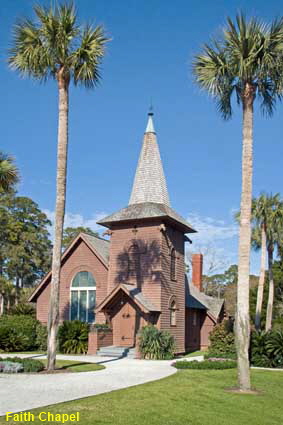
Faith Chapel
The wealthy members of the club needed somewhere to worship, so an interdenominational chapel was built as part of the Jekyll Island Club. In 1904 the club replaced the original chapel with a new one called the Faith Chapel. It was built in the style of an early colonial meeting house, with several elements taken from the Gothic style. Behind the altar is a stained glass window depicting the Adoration of the Christ Child by Maitland Armstrong and his daughter, Helen. At the opposite end is a window by Louis Comfort Tiffany which includes his signature in the lower right hand corner.
Jekyll Island
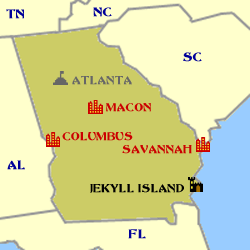
Click on Minimap to navigate
DLU101123




To move forwards or backwards through the Georgia trail click the arrows above, or select your next destination on the Minimap.


© Mike Elsden 1981 - 2025
The contents of this page may not be reproduced in full or in part without permission

