Columbus was established as a trading post in 1828 at the upper limit of navigation on the Chattahoochee River, which forms part of the western border of Georgia. The trading post became a centre for shipping cotton, then. textile mills were built and Columbus soon grew into an industrial centre. The city played a major role in the Civil War, making textiles, swords and ships for the Confederates. It was the site of the last battle of the Civil War. General Wilson had been sent south to destroy Confederate supply centres, arriving on the Alabama side of the river on April 16, 1865. Wilson was unaware that Robert E Lee had surrendered 7 days earlier effectively ending the war, or that President Lincoln had been assassinated. The Union army fought its way across the river and the next day they achieved their mission of destroying the resources that could help the Confederate war effort.
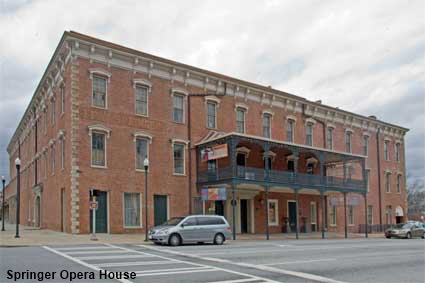
Springer Opera House
Francis Joseph Springer was an immigrant from Alsace, a region in mainland France on the border with Germany. While living in Alsace, Springer had developed a love of theatre, music and dance. He moved to Columbus before the Civil War and became prosperous in the grocery business. He had dreamed that one day Columbus would have a European style theatre, so when the idea of a new performance hall mooted, Springer was ready to provide funds. The Springer Opera House opened on February 21, 1871. The Opera House continued up to the Great Depression, when it was converted into a cinema. In 1958 the cinema closed and within a few years it was threatened with demolition. It was saved and renovated in 1964.
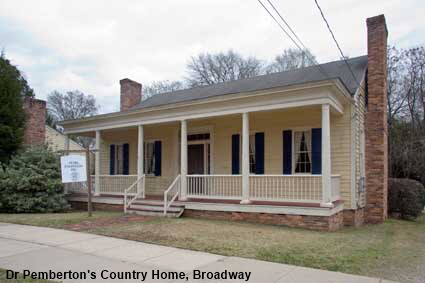
Dr Pemberton's Country Home, Broadway
Dr John Stith Pemberton may not be a name that you may recognise, but you will almost certainly have sampled the product that he formulated. He was a pharmacist who in Atlanta on May 8, 1886 formulated a syrup that was mixed with carbonated water to produce a fizzy drink (soda). It was sold in a local pharmacy and customers liked it. Dr Pemberton’s business partner Frank M. Robinson suggested the name Coca-Cola. Pemberton died in 1888 by which time he had sold all of his interests in Coca-Cola. The Historic District includes two Pemberton houses, the one he lived in from 1855 to 1860 in 7th Street and his country home from 1860 to 1869. In Pemberton’s day it was located about 6 kilometres (4 miles) north of Columbus but it was moved in 1977 to the Columbus Historic District.
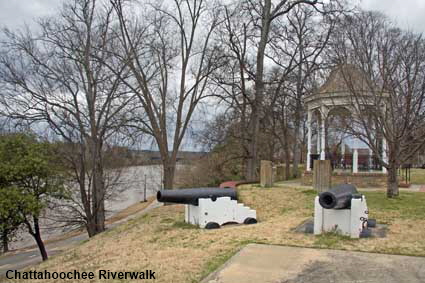
Chattahoochee Riverwalk
A viewpoint beside the Chattahoochee River has a reminder of the last battle of the Civil War in the form of a pair of cannon. The bandstand represents more peaceful times. Below the viewpoint is the Chattahoochee Riverwalk. This is a 24 kilometre (15 mile) long linear park that runs along the bank of the river through Columbus including the Historic Riverfront Industrial District. Open only to walkers, joggers, rollerbladers and bicycle riders, the Riverwalk provides an insight into the past through its many historical markers.
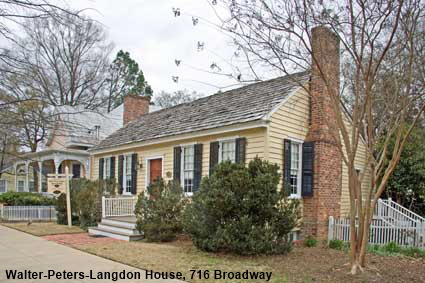
Walter-Peters-Langdon House, 716 Broadway
After World War II the downtown area of Columbus went into decline. In 1966 the Historic Columbus Foundation (HCF) was set up to preserve old buildings in and around Columbus. Just three years later the HCF played a major role in establishing the Columbus Historic District. The area of the Historic District was increased in 1988 and Heritage Corner was established as a tourist site of five structures owned by HCF. The Walker-Peters-Langdon house is one of those structures. It is a simple Federal style cottage which was built in 1828 and it is thought to be the oldest house in Columbus. In addition to the cottage, there is a slave cabin and other outbuildings in the grounds.
Columbus
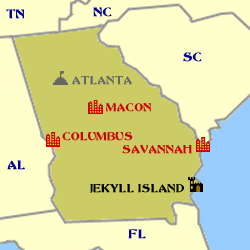
Click on Minimap to navigate
Heritage Park
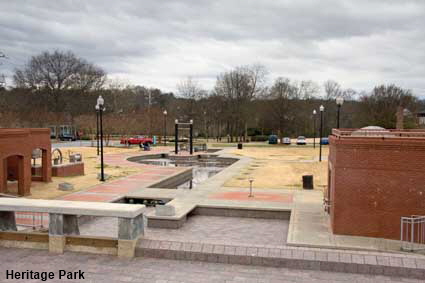
The location of Columbus was determined by the the Chattahoochee river. Downstream the river was navigable for transport while upstream there were rapids that could be harnessed to provide power. A ideal location for an industrial city. Heritage Park celebrates the industrial heritage of Columbus from 1850 to 1910. The outdoor exhibits include sculptures and educational plaques covering a wide range of industries that grew up in Columbus including textiles, gristmills, brick works, foundries, river trade, dams, bridges, agriculture and forest products. In honour of Dr Pemberton there is also an exhibit on Coca-Cola.
DLU101122




To move forwards or backwards through the Georgia trail click the arrows above, or select your next destination on the Minimap.


© Mike Elsden 1981 - 2025
The contents of this page may not be reproduced in full or in part without permission

