Savannah was settled in 1733 by James Edward Oglethorpe and 114 British settlers who had come to set up the new colony of Georgia. The city was planned by Oglethorpe on a grid pattern, the first planned city in America. Settlers plots were interspersed with public squares and parks to create an open and airy city. During the Revolutionary War the city was held throughout by British and Loyalist forces, who repulsed a 1779 attack by American and French troops. In the Civil War, Savannah was the final goal of General Sherman’s scorched earth ‘March to the Sea’. Fortunately the Confederate forces decided to leave rather than surrender, which allowed the mayor to negotiate a surrender that protected Savannah's citizens and their property. Savannah has been well preserved and of the twenty four squares planned by Oglethorpe twenty one are still in existence.
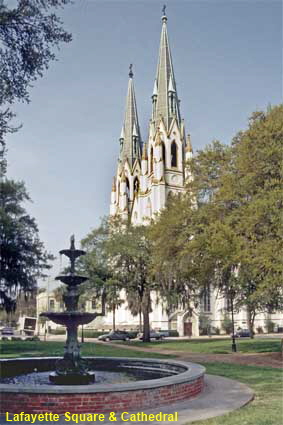
Lafayette Square & Cathedral of St John the Baptist
Lafayette Square dates from 1837 and is named after the Marquis de Lafayette who was an aide to George Washington during the Revolutionary War. The name commemorates an 1825 visit to the city by the Marquis rather than the failed attempt by French and American forces to take the city. The square is has a number of historic buildings, but the most imposing is the Catholic Cathedral. French immigrants established a church in Savannah in the late 18th century and in 1850 the church that they founded became a cathedral. Built on a new site between 1873 and 1896 the current Cathedral of St. John the Baptist was almost lost to fire in 1898, but the walls and spires proved to be strongly built and they survived to allow the cathedral to be rebuilt.
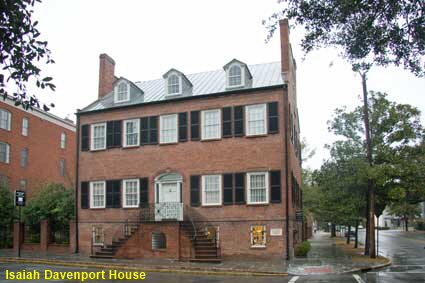
Isaiah Davenport House
Of Savannah’s many historic homes, some remain private residences, some have been converted to Bed & Breakfasts while others are now museums open to the public. The Isaiah Davenport House is one such museum. It was built around 1820 by Isaiah Davenport, a young carpenter from New England. After Davenport died in 1827 his wife converted it into a boarding house. From 1840 to 1949 the house was owned by the Baynard family. By 1955 the area had become run down and the Davenport House was threatened with demolition. It was purchased by a group of local people who formed the Historic Savannah Foundation which has since save many more historic houses in the city. The interior of the house has been restored using and inventory taken after Davenport’s death.
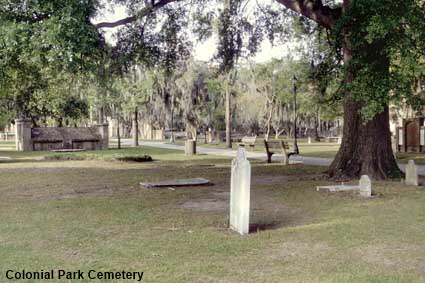
Colonial Park Cemetery
The name gives clue; this is Savannah’s second oldest cemetery and many of the graves go back to colonial times. The oldest cemetery, where the earliest colonists were buried, was by Percival (now Wright) Square, but that site was developed long ago. Colonial Park Cemetery opened in 1750 and was in use until 1850. Among those interred here is Revolutionary War hero Button Gwinnett, who signed of the Declaration of Independence.
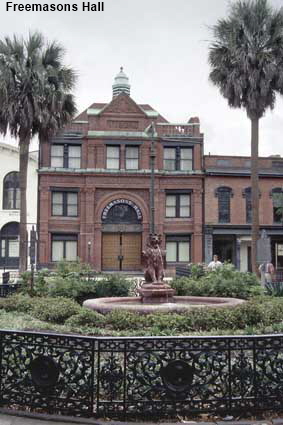
Freemasons Hall
One historic tradition that the colonists brought with them from England was that of Masonic Guilds. The Freemasons are thought to date back as far as the 10th century and remain active to this time although the link to the craft of masonry has long been lost. The colonists wasted no time in setting up their lodge in 1735 and Savannah founder James Oglethorpe was one of its members. The Savannah lodge remains active to this day with the Freemasons Hall built in 1886 the home of Solomon's Lodge No. 1.
Savannah
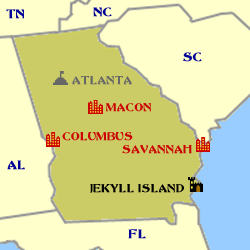
Click on Minimap to navigate
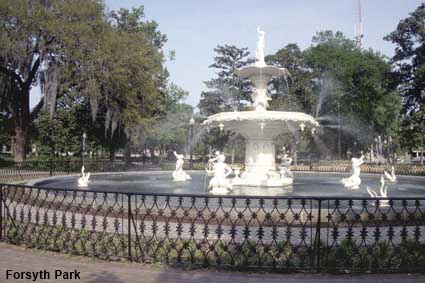
Forsyth Park
Savannah is has many open spaces, but Forsyth Park, created in 1851, is the biggest. The Spanish Moss hanging from the trees derives its moisture from the atmosphere and is characteristic of Savannah because of its humid climate. Click Tab 2 for a closer view of the Spanish Moss.
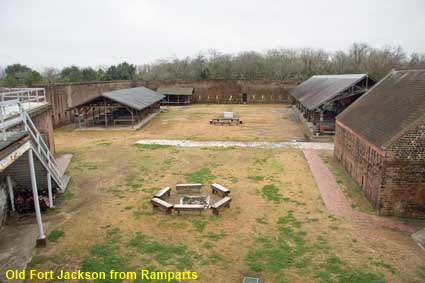
Old Fort Jackson from Ramparts
On the Savannah River to the east of the city is Old Fort Jackson. It was built in 1808, at a time when the US Government was concerned about being pulled into the war between Britain and Napoleon’s France. The fort protected Savannah during the War of 1812 with Britain. During the Civil War it was garrisoned by Confederate soldiers and served as headquarters for the Savannah River defences. Along with the city, the fort fell to Union forces led by General Sherman in 1864 at the end of their ‘March to the Sea’. After the Civil War the fort was abandoned and fell into disrepair. Old Fort Jackson has now been preserved and is run by the Coastal Heritage Society. It is open to the public. Click Tab 2 for a picture of the exterior of the fort taken from the Visitor Center.








To move forwards or backwards through the Georgia trail click the arrows above, or select your next destination on the Minimap.
DLU100722


© Mike Elsden 1981 - 2025
The contents of this page may not be reproduced in full or in part without permission

